How much does a Homelift cost Uk
Home lifts in the UK have had somewhat of a renaissance in recent times. But! How much do home lifts cost in the UK? Once the preserve of the wealthy in large houses, the cost of a home lift in the UK was often a barrier to most. Times have also changed, we are living longer and our home is a lifetime investment. Home lifts cost are, of course, a major consideration, there are some calculations to be done, however, we first need to look at some of the benefits.
Why a Home Lift?
There can be many reasons to consider a Home Lift, we have written a separate post on the very subject, which can be found here.
The benefits of a home lift can be severalfold, moving freely between floors without effort, moving heavy items such as suitcases, or perhaps being able to accommodate a visiting relative or guest, especially if they have mobility issues, The benefits can also include the value a home lift can add to your property. Some might consider it a status symbol especially if customised to reflect your own personality. Perhaps the most compelling reason is to future-proof the home you love, so you will not have to leave it should your mobility be impaired. More independent advice can be found here.
Home Lift Cost
Home lifts cost in the UK is usually determined by the drive system, (hydraulic, traction, pneumatic, chain, rack & pinion), the quality of the materials used in their construction and the finish that lends the lift its aesthetic qualities. Prices range from £ 16,000 to £ 80,000 +vat*.
When installing a home lift, consideration must also be given to the cost of the associated building works which varies according to the design of the lift, especially if the lift requires a shaftway. Building costs can range from £1,200.00 upwards.
*VAT on Home Lifts
In the UK relief from VAT on home lifts is possible in certain circumstances. New build and refurbishments have their own rules, whereas home lifts designed for the use of the chronically sick and disabled can also be zero-rated for VAT with those over 60 years old with no chronic condition paying just 5%.
1. Traction Drive Home Lift Cost – From £16,000+vat* (1 Person) – from £18,000+vat* (Wheelchair Size)
Traction or cable-driven home lift systems use an electric motor, gearbox and cable drum to literally wind the lift up and down using a simple pulley system to provide a low-energy mechanical advantage. These cable or rope systems can sometimes be encased in a belt design. Further Home Lift Information can be found here.
Pros – Floor levelling is very accurate, the lift can be held at a specific floor without the need for constant re-levelling as in the case of a hydraulic system, no separate motor room is required, energy-efficient VVF motor controllers, general principle is more simple therefore lower onward maintenance.
Cons – Because the motor sits on the roof of the cabin or at the ceiling of the upper level, headroom may be an issue in certain properties. There are workarounds however this may involve additional building work.

2. Screw and Nut Home Lift Cost – From £24,000+vat*
Screw and Nut home lift systems use the principle of an archimedean screw, an electric motor either rotates a specialised “nut” around a static screw that runs the length of the shaft or a screw rotates through a static nut. In either case, this draws the platform up and down. Further Home Lift Information can be found here.
Pros – Floor levelling is very accurate, the lift can be held at a specific floor without the need for constant re-levelling as in the case of a hydraulic system, no separate motor room is required, energy-efficient VVF motor controllers, the general principle is more simple therefore lower onward maintenance.
Cons – Can be slightly noisier than other drive types as the motor is within the shaftway, more vibration especially if the lubrication system is not maintained properly, takes up slightly more space.

3. Vacuum Power Home Lift Cost – From £28,000+vat*
Pneumatic or Vacuum home lift systems use vacuum power (atmospheric engine) to lift the home lift cabin. A cabin within a circular shaftway is raised by removing air from above the lift cabin creating a vacuum. The regular atmospheric pressure beneath the cabin then pushes the cabin up the shaft. Further Vacuum Home Lift Information can be found here.
Pros – Compact and space-efficient design, low power consumption, environmentally friendly, floor levelling very accurate, the lift can be held on a specific floor, very low onward maintenance costs.
Cons – Expensive to buy, not suitable for enclosed shaftway

4. Hydraulic Home Lift Cost – from £17,000+vat*
Hydraulic home lift systems use an electric pump to ram oil into a piston that then lifts the platform, to descend an electric valve opens and allows the oil to flow back into a tank ready for the next operation. Some hydraulic systems also incorporate steel ropes or chains to increase mechanical advantage. Further Home Lift Information can be found here.
Pros – enduring reliable technology, energy-efficient as the power is only needed during ascent, pump unit can be remotely located removing noise from the shaftway.
Cons – the use of hydraulic oil is less environmentally friendly, a separate machine room needs to house the pump and tank, can be less accurate when levelling at floors, the environment can affect the operation, especially temperature changes, more difficult to leave the platform at specific floors.

5. Rack and Pinion – From £18,000+vat*
Rack and Pinion home lift drive systems, use a method whereby the rack (a toothed rail) runs the length of travel and the pinion (a toothed wheel) powered by an electric motor, pulls itself up and down the rack. This method is widely used in Stairlift design. Further Home Lift Information can be found here.
Pros – Very compact design, able to run full time on battery power, accurate floor levelling, efficient and low maintenance.
Cons – Limited travel, lower duty cycle (see separate section on duty cycle), slightly noisier than some other designs.
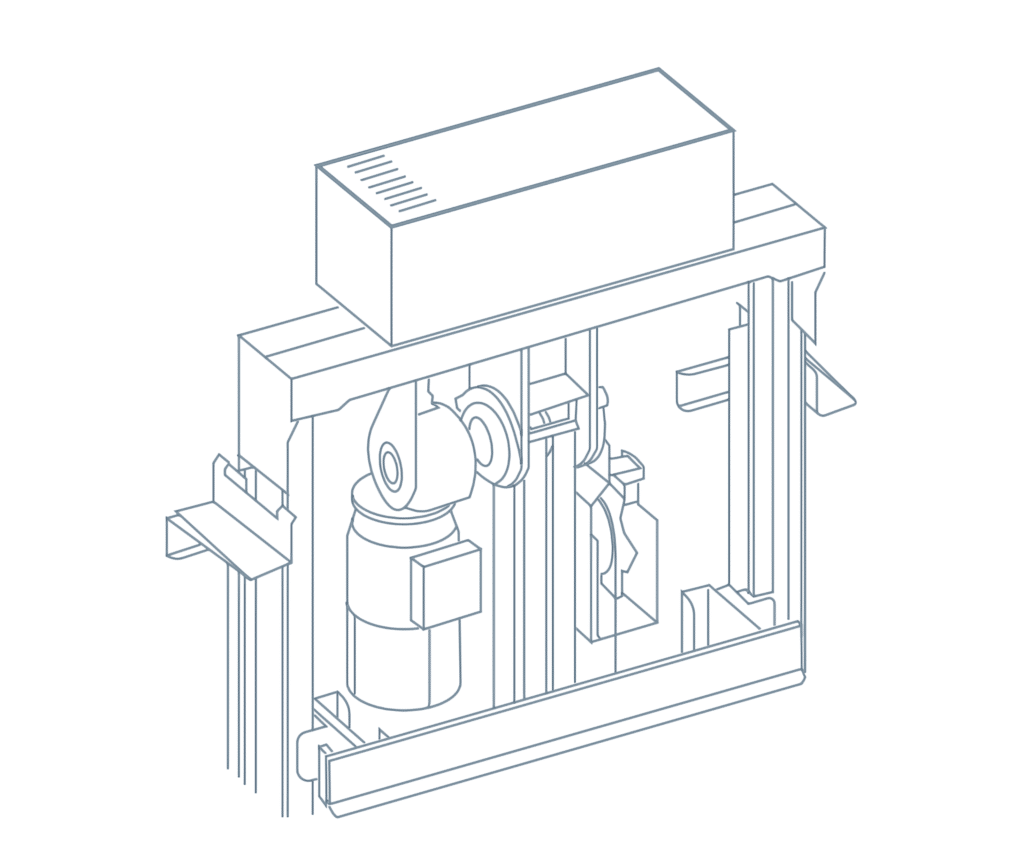
6. Chain Drive – £24,000+vat*
Chain-driven home lift systems use an electric motor, gearbox and driveshaft with sprockets. As the sprockets rotate it drives the chains and raises and lowers the lifting platform. The chain is contained within a cassette to reduce noise and lubrication issues. Further Home Lift Information can be found here.
Pros – Floor levelling is very accurate, the lift can be held at a specific floor without the need for constant re-levelling as in the case of a hydraulic system, no separate motor room is required, energy-efficient VVF motor controllers, general principle is more simple therefore lower onward maintenance.
Cons – No cabin option, slightly noisier and more mechanical in terms of aesthetics.

Starting Cost – Comparison of how much a Home Lift Costs – 2025Some of these prices may exclude building works |
|||
| Drive Method Starting Prices +vat* | Ground to First 2 Stop | Ground – 1st – 2nd 3-stop | 4 or more Floors 4+ Stops |
| Hydraulic | £ 17,000 | £ 28,000 | £ 38,000+ |
| Traction (Rope) | £ 16,000 | £ 45,000 | £ 50,000+ |
| Screw & Nut | £ 24,000 | £ 28,000 | £ 38,000+ |
| Vacuum (Airlevator) | £ 28,000 | £ 32,000 | £ 40,000+ |
| Rack & Pinion | £ 18,000 | N/A | N/A |
| Chain Drive | £ 24,000 | £ 28,000 | £ 34,000+ |
Compare quotes from leading brands
Get Prices in 30 seconds, Compare multiple Manufacturers, Trusted local supplier, no obligation