“An efficient, helpful and professional company. Having had them install a lift for us some years ago, they now service it on an annual basis. Fully recommend. Peter & Philippa at Capel-le-Ferne, Kent.”
Peter Cocks

Whether you’re considering a wheelchair lift for your home or a commercial application, Only Lifts offers a variety of versatile lifts to make your space wheelchair-friendly. We carefully select the best brands that provide the most innovative, reliable and safe mobility solutions.


Need a flexible access solution without the hassle of permanent installation? The wheelchair lift rental is perfect for safe, temporary access to stages and mezzanine levels in schools, theatres, village halls and public buildings. Available to hire or buy, it suits both short-term and longer needs.
This self-contained unit on castors can be wheeled into place and plugged into a standard socket—no building work required. It folds down easily for transport and compact storage, making it ideal where space is limited. Need outdoor access? With optional adjustments, it also functions as a reliable outside wheelchair lift, ensuring smooth entry wherever needed.

The Aritco range operates on a simple yet powerful screw drive system, which is inherently safe and particularly suited to limited spaces. Aritco is an award-winning manufacturer of platform and home lifts for both public buildings and private residences. There are three home lift designs to choose from; each comes with customisation options allowing you to create the perfect solution for your needs. Designs range from the most compact and space-efficient to lifts that are large enough to accommodate a pushchair and a wheelchair. Aritco also provides high-quality, reliable platform lifts for public spaces, designed for ultimate comfort and safety. The range includes options suitable for both new and existing buildings.

Another innovative contender in the wheelchair lift space is the CantiLift™ aka Panova cantilever lift. This wheelchair lift is manufactured in the UK and was designed by a former aeronautical engineer. When at rest, it is completely flush with the lower landing floor, allowing the surrounding floor covering to be inlaid with carpet tiles, vinyl, wood or even stone or marble for a superior look.
Once a wheelchair is positioned on the platform, safety barriers rise at each side to prevent the user from rolling over the edge. The lift is then gently propelled by its ingenious hydraulic design. However, the real magic happens when the platform clears the floor service and starts to curve up and over the stairs to reach the upper landing point. The security barriers then lower to allow the user to exit the platform.
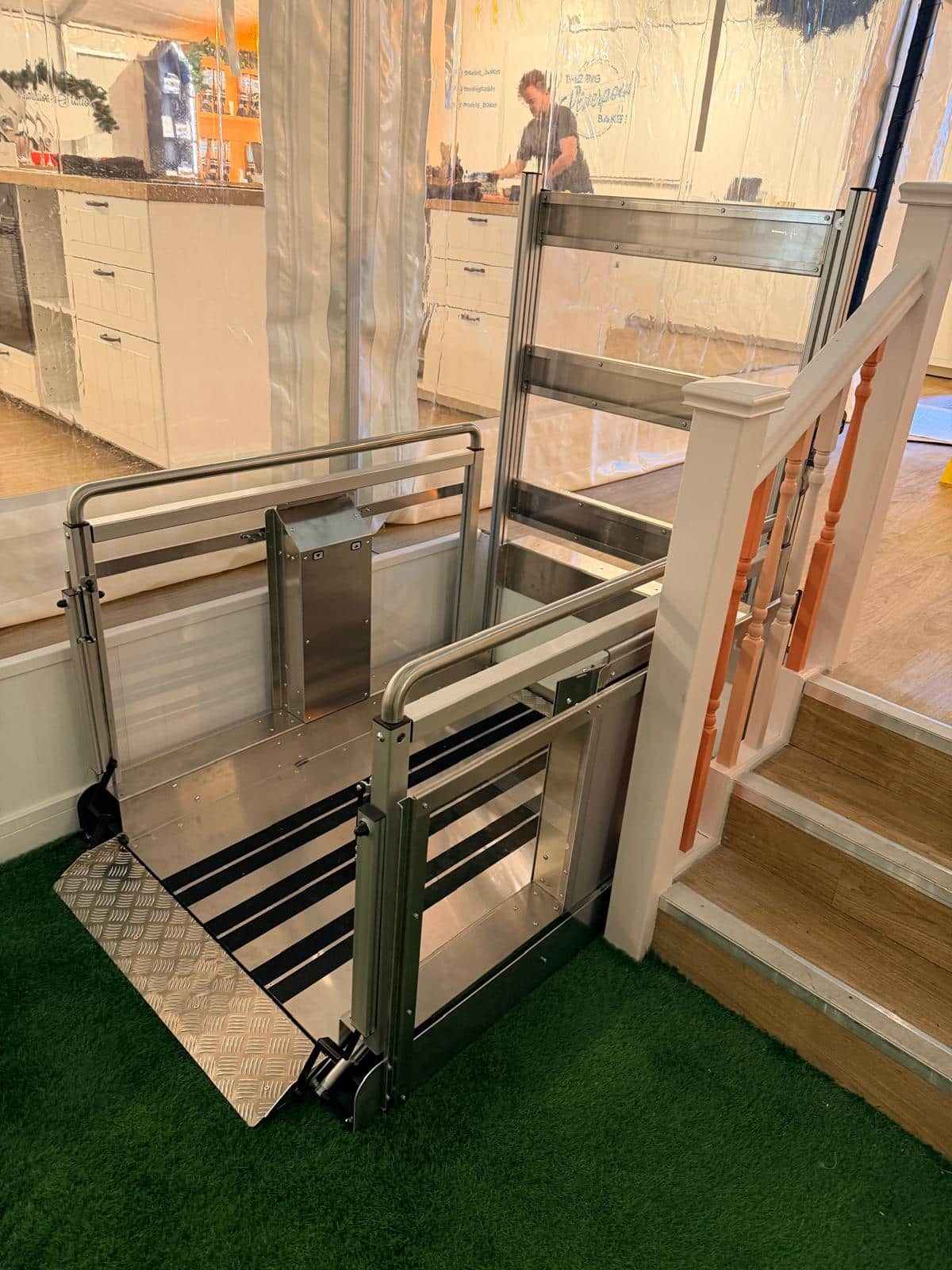
Tech Lift M4: easy to install compact platform lift solution with modern seamless glazed doors
Installing a Tech Lift M4 is a cost-effective way of making outdoor and indoor spaces accessible without having to make structural modifications or carry out building work. This ultra-compact, low-level access lift solution has a maximum travel height of 1.5 metres and comes in three different platform sizes. The intelligent lifting mechanism, which comprises of four telescopic legs, requires minimal floor space, making the Tech Lift M4 ideal for tight spaces and existing building layouts.
Recently upgraded with seamless glazed doors as standard, the Tech Lift M4 combines functionality with elegant aesthetics. Clean architectural lines complement any environment. This contemporary disability access lift, which is suitable for residential and commercial environments, comes in silver or black as standard.

The Miesian Lift range utilises a screw drive system. It is as suitable for installation in private homes as it is in commercial environments and public buildings, with its use of glass and contemporary housing offering wheelchair access in style. This established brand offers comfort, reliability and safety with beautifully elegant design. The Meisian Lift further stands apart from other designs, by being available in a vast variety of platform sizes. Essentially meaning we can fill a limited amount of space more efficiently than any other wheelchair lifts on the market. This feature make this lift ideal as a direct replacement for older lifts such as the Hammond & Champness chain drive lifts of 30+ years ago.
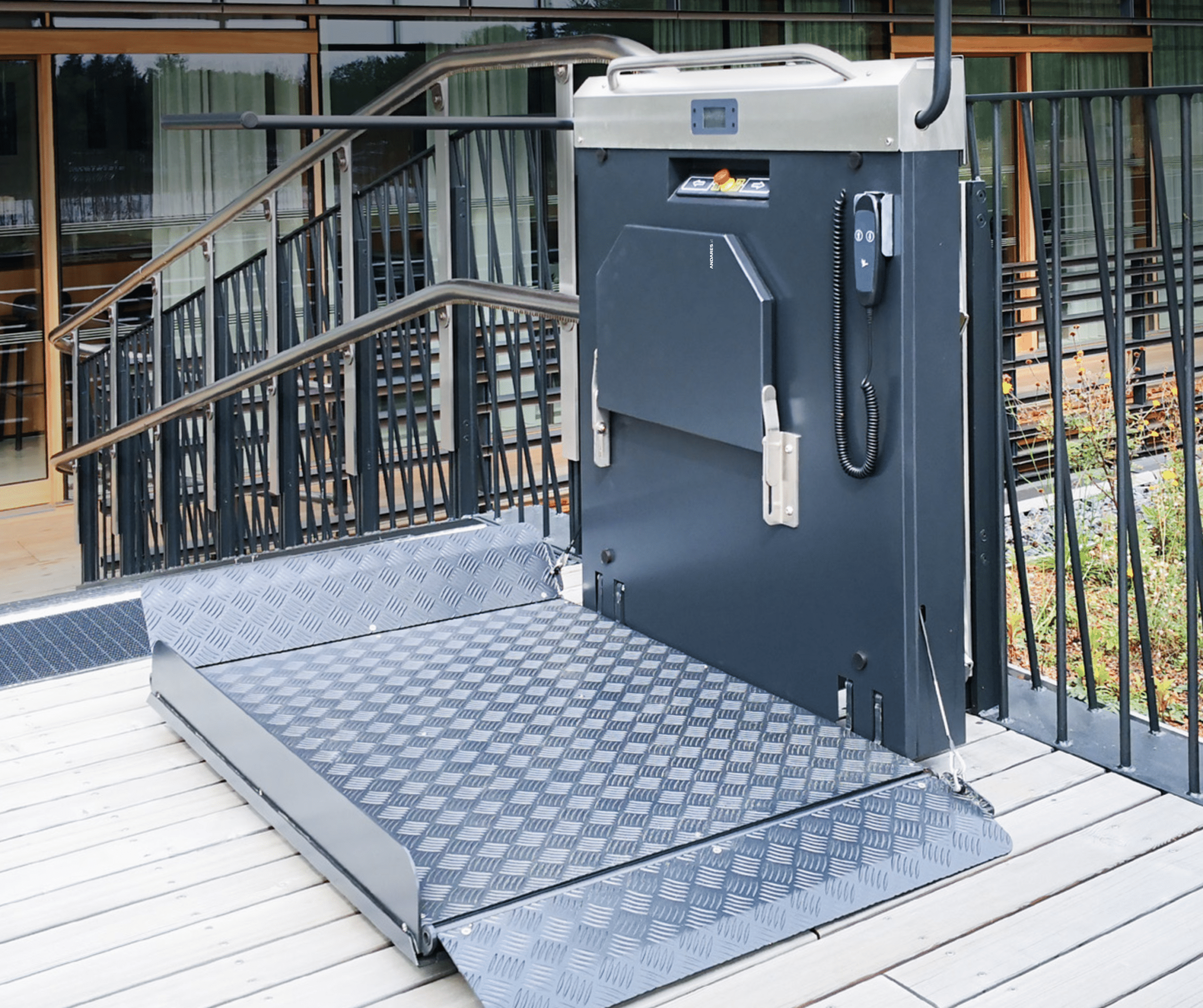
The Ganser Inclined Platform Lift is a stairlift that can carry wheelchairs. Although predominantly used in commercial and public buildings it can also be used to access the home. Only Lifts offer the Ganser Inclined Platform Lift because of its quality construction and compact design. This lift is ideally suited to homes with limited space as the platform folds away when not in use with the press of a button.

Access BDD’s Supra Linea is a cutting-edge inclined platform stairlift, meticulously designed for straight staircases with consistent gradients. This model is crafted to satisfy the demands of users who seek unmatched comfort and superior quality.
The Supra Linea leads in design and ergonomic advancements, built solely with premium-quality materials. These stairlifts offer an optimal solution for overcoming architectural challenges, making your facility universally accessible.
“Very good service generally. Engineer and office staff both efficient and helpful.”
Mrs Winder
“Fantastic, hassle free friendly service, perfect product, thanks.”
N S
“They are always willing to come out if anything goes wrong, the servicing is very good also very professional.”
Janet miles
“First class service from start to finish. Competitive price for a rental stairlift which was fitted within days. When sadly it was removed it was done on the same day as I called. Thank you Only Lifts for excellent product and service.”
Michelle Robinson
“We have used Only Lifts Ltd for a number of years. They has serviced our stairlift until it was no longer required. Highly recommend them for a friendly, efficient service.”
Clare Westgate
“I am really impressed with only lifts, he is polite friendly and professional, nothing is ever too much for him, first-class service.”
Linda Haffenden
Request a free no-obligation assessment with a Trusted Assessor to discuss your wheelchair lift requirements. We’ll use our three decades of experience of working with architects, specifiers and design and build contractors to recommend the right solution for you and provide your organisation with a no-obligation quote.
If you’re considering buying a lift for the first time, the choice available can be a little overwhelming. We’ve cut through the jargon to give you a simple explanation of the different types of lifts available. It is firstly useful to understand the difference between the lifts you may find in everyday life. The traditional most common type of lift is known as a passenger lift, it is the best solution in high traffic areas. Fully automated, with higher speeds and often sideways sliding doors, the typical passenger lift is very familiar. The downside to passenger lifts is the cost, the amount of space required and ongoing maintenance costs. Passengers lifts are the first stop solution however, should you need to provide wheelchair access but neither have the space or budget for a passenger lift then a wheelchair platform lift may be the solution. Cheaper, smaller and easier to maintain could be the solution you are looking for. There is of course a trade off for all these benefits compared to a passenger lift. However, for shorter travel distances and limited space and budgets they could be ideal.
A platform lift travelling over 3 metres is a fully enclosed shaft with an L-shaped platform that moves between two or more floor levels carrying a wheelchair and its user. This is a cost-effective option for people who struggle to negotiate stairs. A wheelchair lift requires minimal space, is reliable, quiet and completely safe. Often overlooked is the benefit this type of lift offers to parents with buggies or prams, removing the risk associated with climbing stairs.
A wheelchair platform lift travelling less than 3 metres may be an open type, shaftless design. This not only reduces cost but can speed up the installation process. Even more compact than the enclosed platform lift, this could be the best solution where space is even more restricted.
Traditional Passenger lifts usually come in two drive system types, Hydraulic or Traction. In simple terms, the hydraulic lifts are powered by a pump that sends oil to a ram that moves the lift up and down. Traction lifts use steel cables or belts to pull the lift up the lift shaft; a counterweight assists with this action. There are many designs and variations of platform lifts.
Only Lifts can offer all these various drive systems. Contact us to discuss which is the best option for you.
With Only Lifts, you can rest assured you’ll receive the best lift solutions on the market today, installed to high standards and in full compliance with the required standards. Once your new unit is installed to your exact aesthetic brief, we’ll show you and your staff how to operate it. We offer a full aftercare service, so should you ever need advice, maintenance or wheelchair lift repair, you can call our 24/7 support line to speak to an engineer.
Before installing a wheelchair lift, our Disabled Living Foundation-trained Trusted Assessor will conduct a no-obligation assessment to determine your requirements. We’ll use our 30+ years of experience of working with architects, specifiers and design and build contractors to recommend the right solution for you
With Only Lifts, we make the process from assessment to ready-to-use as quick, easy and hassle-free as possible.
Before installing a wheelchair lift, our Disabled Living Foundation-trained Trusted Assessor will conduct a no-obligation assessment to determine your requirements. We’ll use our 30+ years of experience of working with architects, specifiers and design and build contractors to recommend the right solution for you.
We’ll provide you with an affordable quote and clear timeline. This isn’t an estimate subject to change, so the price we quote is the price you pay.
With Only Lifts, you can rest assured that you’ll receive the best lift solutions on the market today, installed to high standards and in full compliance with the required standards. Once your new unit is installed to your exact aesthetic brief, we’ll show you and your staff how to operate it. We offer a full aftercare service, so should you ever need advice, maintenance or wheelchair lift repair, you can call our 24/7 support line to speak to an engineer.
If you have any more questions about this product then don’t hesitate to contact us and we will get back to you as soon as possible
Only Lifts sources the best brands that offer reliability, safety and innovative design. We install a wide range of wheelchair lifts, including wheelchair platform lifts, wheelchair stairlifts and sizes to suit all needs and space requirements. If you’re unsure about which type of wheelchair lift would best suit your needs and home/premises, please get in touch — we’re here to answer your questions and provide advice and support.
Every installation and client requirements are different however as a guide you should budget the following plus any associated building works if these are required.
When our Trusted Assessor has determined your requirements, we will provide a no-obligation quote and a clear timeline for delivery and installation. Typically lead times range from four -12 weeks depending on the product. Installation typically takes between one and five days.
The major difference between a personal lift and a wheelchair lift is the size of the platform. A wheelchair needs considerably more space than a person sitting or standing. Clients are often surprised by how much space some wheelchair lifts take up. Fortunately, Only Lifts can offer some of the worlds most space-efficient wheelchair lifts. Innovations in design and technologies now allow us to find a solution that not only meets the needs of the end-user but fits into the available space. When dealing with wheelchair lift installations outside the home a number of rules and legislation come into play. Our Trusted Assessor will advise you in all cases, guiding you through the process.
Only Lifts installs the best brands from leading manufacturers of wheelchair lifts. Every lift has a different level of noise and type of sound. Noise levels are a key design consideration. Clients often comment on how quiet the lifts are — 55-60 db (decibels) is a typical noise level for a screw drive lift. To provide some context, a washing machine on a standard programme creates a noise level of about 77 db.
We can’t guarantee your lift will be silent when in operation but the advanced engineering of the designs we sell allows them to move with minimal noise.
Yes, some Altura home lifts can be designed to accommodate wheelchairs. Certain sizes within the Altura range are suitable for wheelchair users and conforms to all relevant accessibility standards. They can be equipped with wider entrances, spacious cabins, and features like ramps or foldable seats to facilitate wheelchair accessibility.
The Altura Home Lift can travel up to 5 floors making it one of the most versatile home lifts when it comes to travel distance
Home lifts require appropriate structural support, and it’s important to consult a professional to assess the strength of your walls. In some cases, additional support may be necessary, such as the installation of load-bearing walls or structural modifications to ensure the lift is properly supported.
Some models may have a small ramp or threshold at the entrance, while others can be designed with a flush floor that eliminates the need for a step. In this case a shallow pit is required.
If you have further questions about our products and services, please contact us. When you get in touch with us, you won’t have to worry about a sales pitch at the end of the call or non-stop follow-ups asking for “a moment of your time”. We’re here to answer your questions and provide advice and support to help you choose the right mobility solution for your needs.
To discuss your needs with a Trusted Assessor and receive a no-obligation assessment and quote, fill in the form and we’ll be in touch. We’re committed to helping you find the right solution.